A very difficult article to write

A couple of years ago I made a commitment, knowing that one of the consequences would be a responsibility to write something that makes me very uncomfortable. Today is the day that I must pay off that debt.
Today is my birthday. That in itself is not a problem. Several years ago I decided to remain 27, and see no reason to change that - indeed with each birthday my motivation to stick with that strategy gets stronger.
Instead, the problem, like so many, starts on Facebook. Although I don't post my birthday on Facebook, they know when it is. And so, this morning, I opened my page to find the following suggestion:
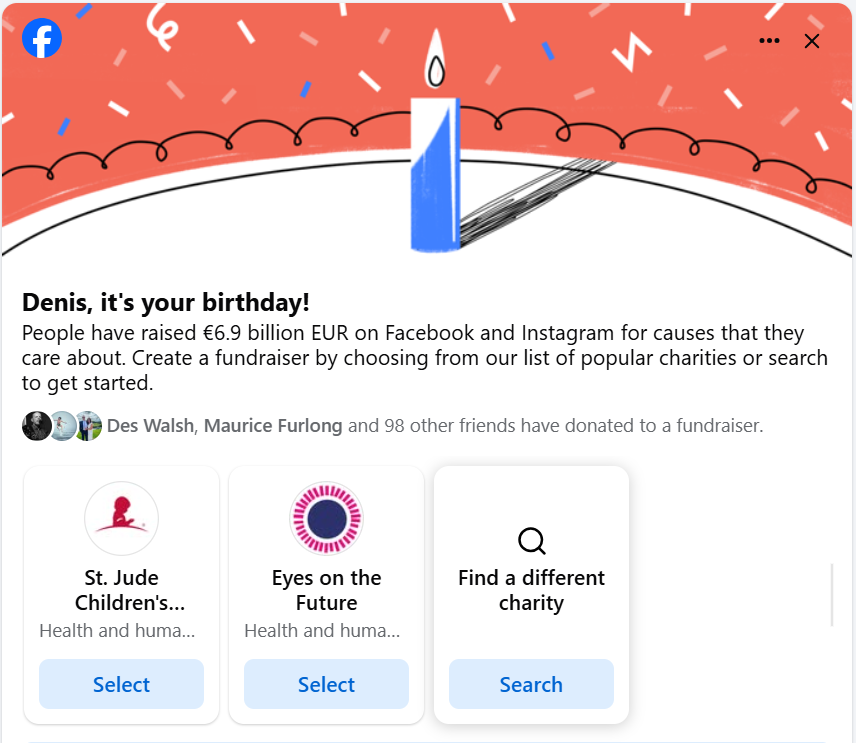
What a wonderful idea! Why not use my birthday to help a good cause? I love this way of thinking.
And the first charity suggested, St. Jude's Children's Research Hospital, world-renowned for leading the fight against children's cancer. Everyone one of us, unfortunately, has known a child or a parent who has dealt with this tragedy. Stephen Fry famously said that if he died and to his surprise discovered that there was an omnipotent, omniscient god, he would say to him "How dare you! - how could you knowingly allow children to get cancer?" Is there a more deserving, more noble cause in the world than helping to cure cancer in children?
So I really admire the generous people who donate to St. Jude's, the wonderful, brilliant people who work there, and everything they do.
So, which part of this is so hard to write?? It all sounds like platitudes and cliche's, probably written by AI.
It's the next part that's hard:
I'm now going to suggest that maybe supporting St. Jude's is not a great idea.
And I specifically choose St. Jude's for all the reasons above - that no sane, decent person could argue that it is not a wonderful charity, or would have anything but admiration for everyone associated with it.
I don't want to make this article easier to write by choosing a charity that is flawed or corrupt or incompetent, or a "charitable fund" that enables billionaires to avoid tax and supports very rich colleges to build football stadiums and so on.
St. Jude's is a very good charity, in many ways a role-model.
In 2024 I co-founded an organisation, Effective Giving Ireland, after completing an incubator in a wonderful organisation called Charity Entrepreneurship (now renamed AIM). Effective Giving helps donors to find the most impactful way to donate, based on cold science and logic - yes, I'm an engineer, in case that wasn't already obvious.
Effective Giving can feel, in some ways, like the antithesis of the warm, fuzzy glow that you feel after you donate to a great charity like St. Jude's. There are no thank you cards, no photos of the children who have recovered thanks to your generosity, no glossy magazines that you can leave on the table so people can see and maybe be inspired to replicate your generosity.
All this is replaced by one detail - one number.
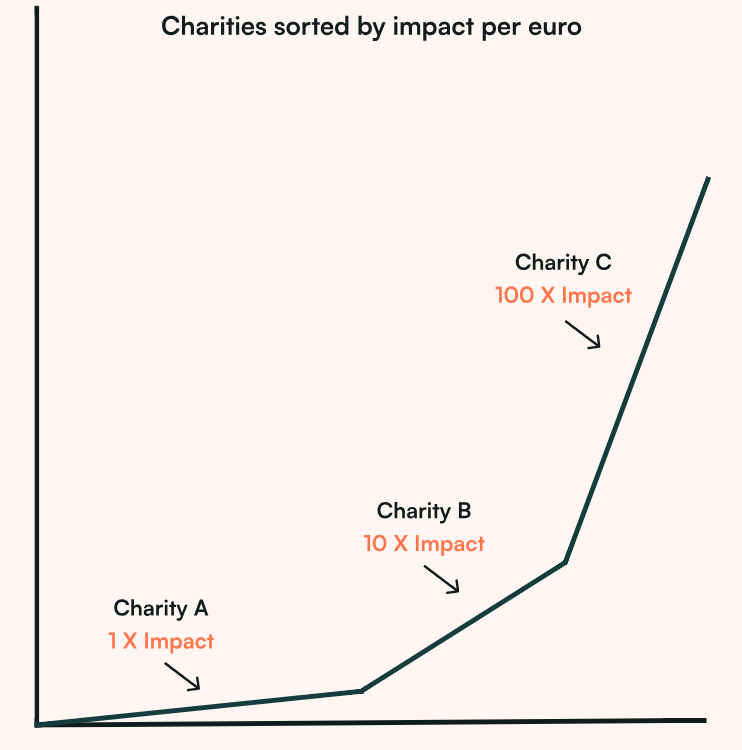
You will probably save about 100 times as many children by donating to an Effective Charity than by donating to a charity like St. Jude's.
I am not making this number up: here is a full, quantitative analysis of the impact assessment, leading to the graphic below. This is not based on over-simplistic analysis, it does not neglect secondary impacts or long-term impact of research or anything like that.
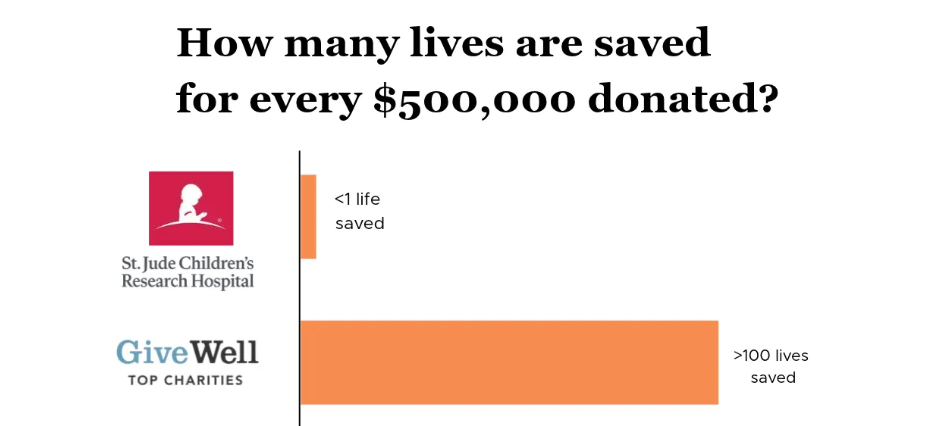
And again, let me repeat for the nth time: St. Jude's is a great charity, far better than many others, with a very worthy goal, highly transparent and ethical management and demonstrably good results.
So, what gives?
It's simple really.
In an ideal, decent, fair world, a charity like St. Jude's would be at the cutting edge of effective charities, doing critical work on an important cause, helping children directly and indirectly by working on curing diseases that we cannot cure today.
However, in our highly imperfect world today, millions of children die from highly curable or preventable diseases. And, bluntly, it costs far less to save them. In developing countries, just providing basic medicines, mosquito nets, natal care, clean water and hygiene ... these simple, well-understood steps can saves children's lives on a massive scale.
It is an absolute scandal that our world governments allow this situation to exist, but they do. And as long as they do, each one of us has the potential to do our bit, to save and give a healthy, long live to an infant who would otherwise have died needlessly, for a paltry sum, probably less than $5000.
And so, when you generously put your hand in your pocket and decide to give some of your hard-earned money to help others, you have two opportunities.
- On the one hand, you can donate to a charity like St. Jude's, which does great work, but which, because of the nature of the work it does, has a relatively small impact per euro/dollar they receive. You will be able to see the impact of your donation in the work they do, the children they treat and the cures they help to create.
- Or you can donate to a Givewell-recommended charity, which can save 100 times as many children for the same donation. You will never know which children you saved, they will never thank you because they themselves do not know they have been saved, that they would have died, but instead now they will just grow up healthy because your donation prevented their needless deaths from preventable causes.
I hate to write this because if I am in a group of 100 people and one of them works for someone like St. Jude's, that person immediately has my respect and admiration. And if I am discussing how to spend a spare €1000 with a group of people who talk about holidays and bikes and stereos and Michelin-star dinners, and one person says "no, I want to donate it to St. Jude's" - again, that person has my total admiration.
But in the world we live in, the real world, there is a part of me that wants to ask people "Instead of donating to St. Jude's, are you aware that you could save 100 times as many children by donating to a Givewell-recommended children's charity?"
Or better, I want to ask: "In addition to donating to St. Jude's, are you aware that you could save 100 times as many children by also donating the same amount to a Givewell-recommended children's charity?" But not everyone can afford to double their donation ...
I want to live in a world where no children or adults die from easily preventable causes, in a world where donating to a charity like St. Jude's is truly the best thing I could do with my money. I would encourage every one of us to do everything we can to create such a world, to absolutely condemn selfish politicians who cut rather than increase international aid, or who "re-assign" it so that it effectively is spent in their own country, to condemn governments who spend more on weapons than on providing basic health needs for their citizens, to insist that we live up to our funding commitments to UN bodies, to condemn wars and embargos and sanctions that hurt children in the poorest countries.
And what is so frustrating is that we know this can be fixed. Poverty is a huge driver of preventable deaths of children. If we compare what is happening in Asia vs. Africa, the difference is dramatic. While there is still extreme poverty in some parts of Asia, the progress there has been outstanding over the past decade, and we are on the road to eliminating it. In a world where there is so much bad news every day, the wonderful news about moving people out of dire poverty in Asia somehow never makes the headlines.
But in much of Africa, the challenges are greater and sometimes it feels like the political willingness to help is not as strong.
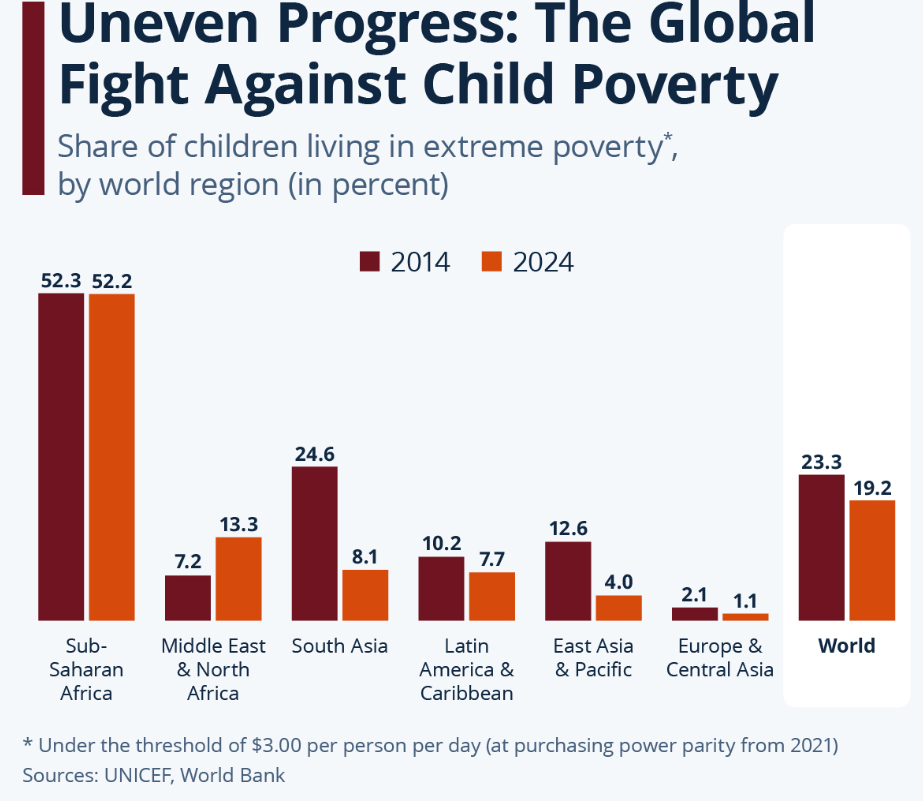
Most of us cannot fix this. If you are reading this as a Minister of Finance or a Prime Minister in a rich western country, you could certainly do something to help. But for most of us, the best we can do is vote for the candidates who seem most likely to do the most good, and, in the meantime, do what we can with our individual donations.
And I would suggest, for the moment at least, we should really consider using those donations to support the charities which save the most children. Here are some places where you can find out about them: